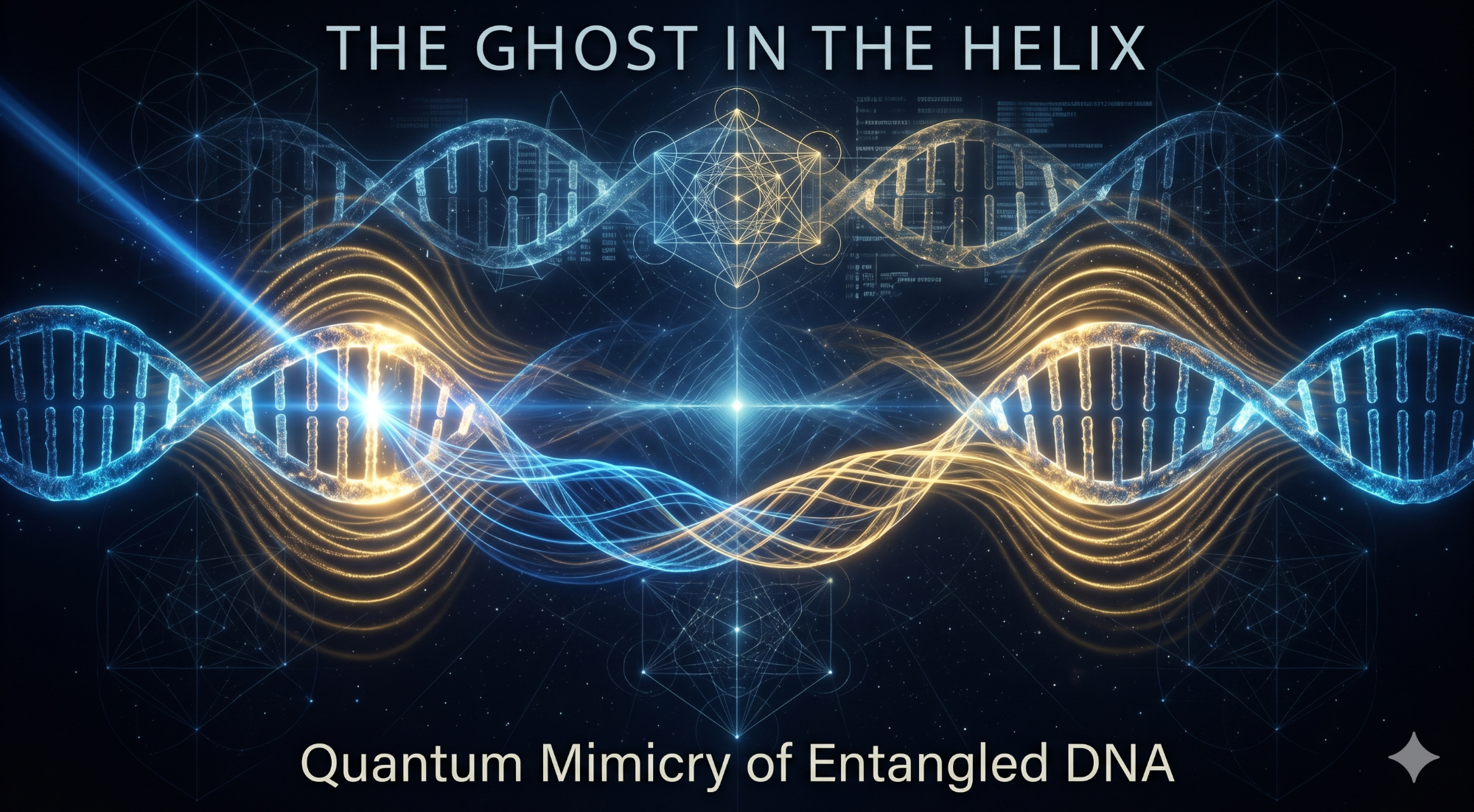
Article 7. The Ghost in the Helix: Quantum Entanglement and the Mystery of DNA “Mimicry”
For decades, we viewed DNA solely through the lens of classical biology: a rigid, double-helix scaffold of chemical bonds, the ultimate blueprint for building life. But at the 24-year mark of intensive research into how cellular voltage and atomic architecture dictate human restoration, a new, more mysterious paradigm is emerging—one where DNA is not just a chemical database, but a sophisticated quantum logic processor.
Perhaps the most fascinating phenomenon emerging from the frontier where quantum physics meets molecular biology is the concept of Non-Local Biological DNA Communication and what we term DNA Mimicry.
The Core Concept: Quantum Biological Entanglement
To understand how DNA can "mimic" behavior across separate parts, we must enter the strange world of quantum mechanics. The fundamental concept is Quantum Entanglement. When two particles become entangled, they share a unified quantum state. They are no longer separate entities.
Non-Local Connection: If you measure or act upon one entangled particle, the other immediately reflects that change, no matter how far apart they are. This is "Spooky Action at a Distance."
The DNA Superconductor: My research focuses on DNA as a superconductive biological battery, holding a cellular voltage Anthem of -70mV. In this state of superconducting harmony, the delocalized electrons that stack along the core of the helix are not localized to chemical bonds; they behave as a single, collective entity—a Super-Atom. This unified electron cloud becomes the ideal channel for quantum phenomena.
The Blueprint of Separation and Non-Local Mirroring
We are beginning to understand how this classical-to-quantum shift allows separated DNA fragments to remain functionally connected. When a DNA sequence is replicated, the electrons that stacked along the initial parent strands are effectively separated, yet they can retain their shared, entangled state.
New pilot research supports the groundbreaking theory that DNA functions as a logic processor via this electron entanglement. The implications are staggering: if you stimulate one strand of DNA (Segment A) using laser pulsations, you do not just observe an acoustic depolarization in that strand.
Simultaneous Mimicry: A cloned, separated strand (Segment B) will mirror the exact same synchronized pattern of depolarization—instantly. This is a demonstrated "non-local communication" system within biology, functioning without any physical connection or standard electromagnetic signaling.
Vanishing Impedance and the Phantom Field
This non-local mimicry only occurs when the DNA remains superconducting. In my methodology, when we use Acoustic Lockpicks (such as 40Hz and 20Hz frequencies) to melt the Cellular Bunkers of impedance, we vanish the resistance that usually keeps the helix trapped in a "finite state."
When impedance vanishes, the DNA doesn’t just communicate non-locally—it leaves a ghost. Observations have shown that DNA molecules can continue to influence biological systems and scatter laser light even after the physical DNA was removed from the experimental chamber. The remaining structure—a lasting "phantom" or informational field—suggests that the quantum blueprint persists.
The New Blueprint for Restoration
We aren't just looking at interesting physics experiments; we are looking at the new roadmap for cellular renovation. We have always struggled to explain how distant cells synchronize their behavior for rapid healing or how an Inner Child’s core blueprint of health persists after years of trauma-based impedance.
If DNA maintains its most vital informational structures via non-local entanglement, we don’t need to "re-write" the blueprint. We simply need to restore the correct cellular voltage Anthem (-70mV) and melt the locks. Once impedance vanishes, the body immediately plugs back into its True Still-Point Blueprint—the infinite sea of potential energy where its original, entangled, perfect form still resides.